Building Transparent AI Agents with Audit Trails and Human Gates
This article was written by AI based on multiple news sources.Read original source →
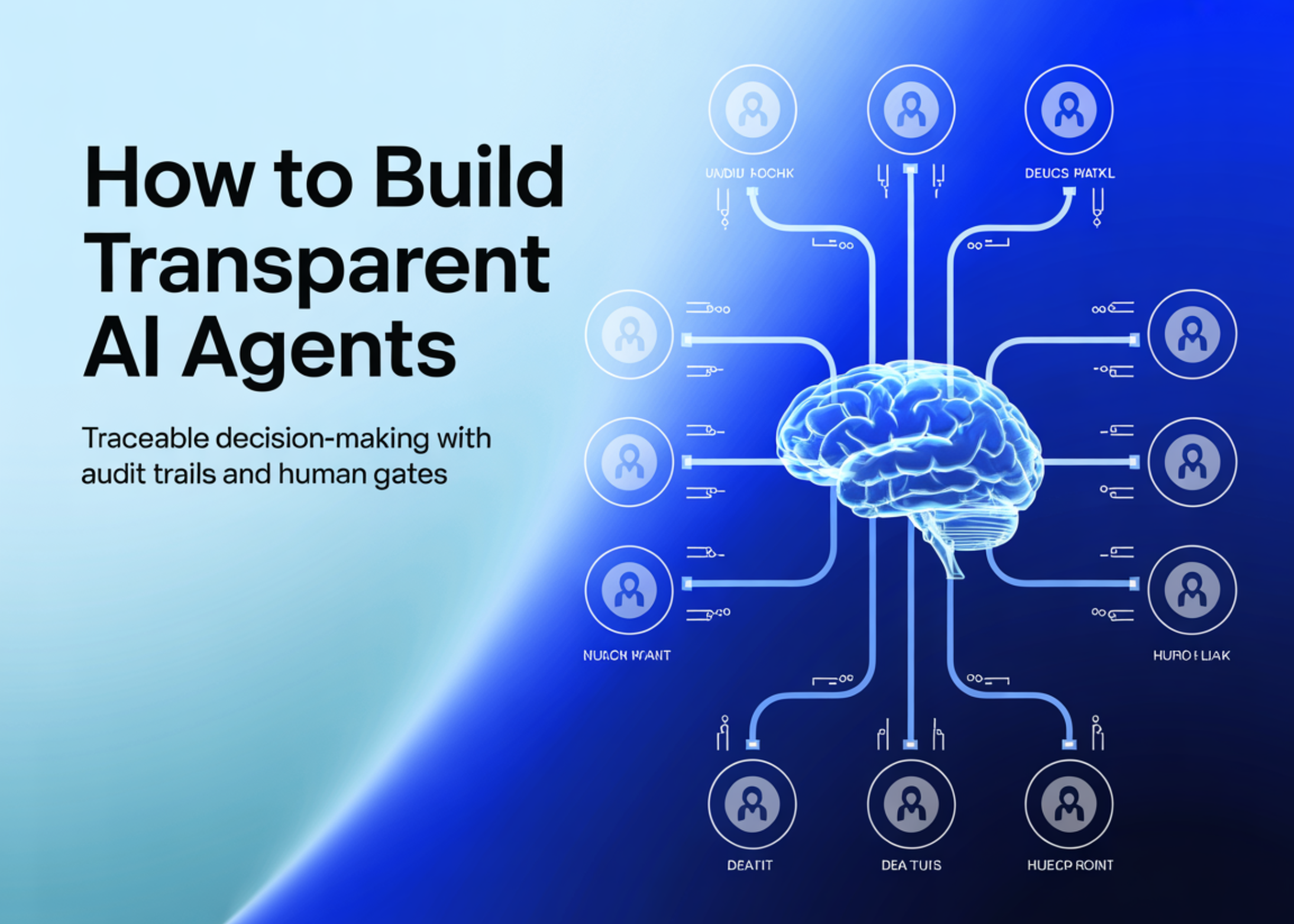
As AI agents move from simple assistants to autonomous systems making consequential decisions, the demand for transparency and control has never been greater. A new technical approach is emerging to address this critical need, focusing on building 'glass-box' agentic workflows where every decision is traceable, auditable, and explicitly governed by human approval. This methodology moves beyond the opaque 'black box' nature of many current systems, aiming to make the internal reasoning of AI agents as clear and accountable as a traditional software log.
The core architectural principle involves designing systems that log each discrete step of an agent's process—every thought, action, and observation—into a structured and tamper-evident audit ledger. This creates a comprehensive, chronological record of the agent's decision-making journey, from initial prompt to final output. Unlike standard application logs, this audit trail is specifically engineered to capture the agent's cognitive process, providing a verifiable chain of reasoning that can be reviewed, analyzed, and challenged if necessary. This traceability is fundamental for debugging complex agent behaviors, ensuring compliance with internal policies or external regulations, and building user trust in automated systems.
Complementing the detailed audit trail is the concept of dynamic permissioning and human gates. This mechanism enforces explicit human approval for actions deemed high-risk or outside of predefined safe parameters. The system is designed to dynamically assess the context and potential impact of an agent's proposed action. For instance, an agent tasked with financial transactions might autonomously handle small, routine transfers but be required to pause and seek human authorization for any payment exceeding a certain threshold or destined for a new, unverified account. These 'gates' are not static roadblocks but intelligent checkpoints that understand the stakes of a given situation, ensuring human oversight is applied precisely where it is most needed without crippling the agent's overall efficiency.
Implementing such a transparent system requires careful design from the ground up. The agent's architecture must be modular, with clear separation between its reasoning engine, action executors, and the logging/oversight layer. Each module must emit standardized events that feed into the central audit ledger. Furthermore, the logic for triggering human gates must be robust and context-aware, relying on more than simple rule-based thresholds to include an assessment of novelty, potential for harm, or alignment with ethical guidelines. The human-in-the-loop interface itself must be intuitive, presenting the agent's reasoning from the audit trail clearly and concisely so that a human reviewer can make an informed approval or correction decision rapidly.
The implications of this transparent agent design are significant for enterprise adoption. In sectors like healthcare, finance, and legal services, where decisions have serious consequences and regulatory scrutiny is high, the ability to audit an AI's decision path is non-negotiable. It transforms AI from an unexplainable oracle into a accountable team member whose work can be validated. For developers and companies, building with transparency and auditability from the start mitigates future risks related to compliance, liability, and public trust. It represents a maturation in AI engineering, prioritizing governance and safety alongside raw capability. As agentic AI becomes more powerful and pervasive, frameworks that bake in traceability and human oversight will likely become the standard, not the exception, defining the next generation of trustworthy autonomous systems.
Key Points
- 1The methodology focuses on creating 'glass-box' agentic workflows for full traceability and auditability.
- 2A core component is a tamper-evident audit ledger that logs every thought, action, and observation.
- 3The system enforces dynamic human-in-the-loop gates for authorization of high-risk or novel actions.
As AI agents take on more autonomous, high-stakes tasks, frameworks for transparency and human oversight are essential for enterprise adoption, regulatory compliance, and mitigating risk.