LangChain Tutorial Details Agentic Workflow for Logistics Route Optimization
This article was written by AI based on multiple news sources.Read original source →
Building reliable AI agents for real-world business operations requires moving beyond simple text generation to orchestrating precise, deterministic tools. A new technical tutorial demonstrates how to construct a production-ready Route Optimizer Agent for a logistics dispatch center using LangChain's latest agent APIs. The core challenge addressed is ensuring the agent performs accurate, verifiable computations for critical tasks like distance calculation, estimated time of arrival (ETA) prediction, and route optimization, rather than making unreliable guesses. This approach prioritizes deterministic outcomes and structured data outputs, which are non-negotiable for operational systems where errors have direct financial and logistical consequences.
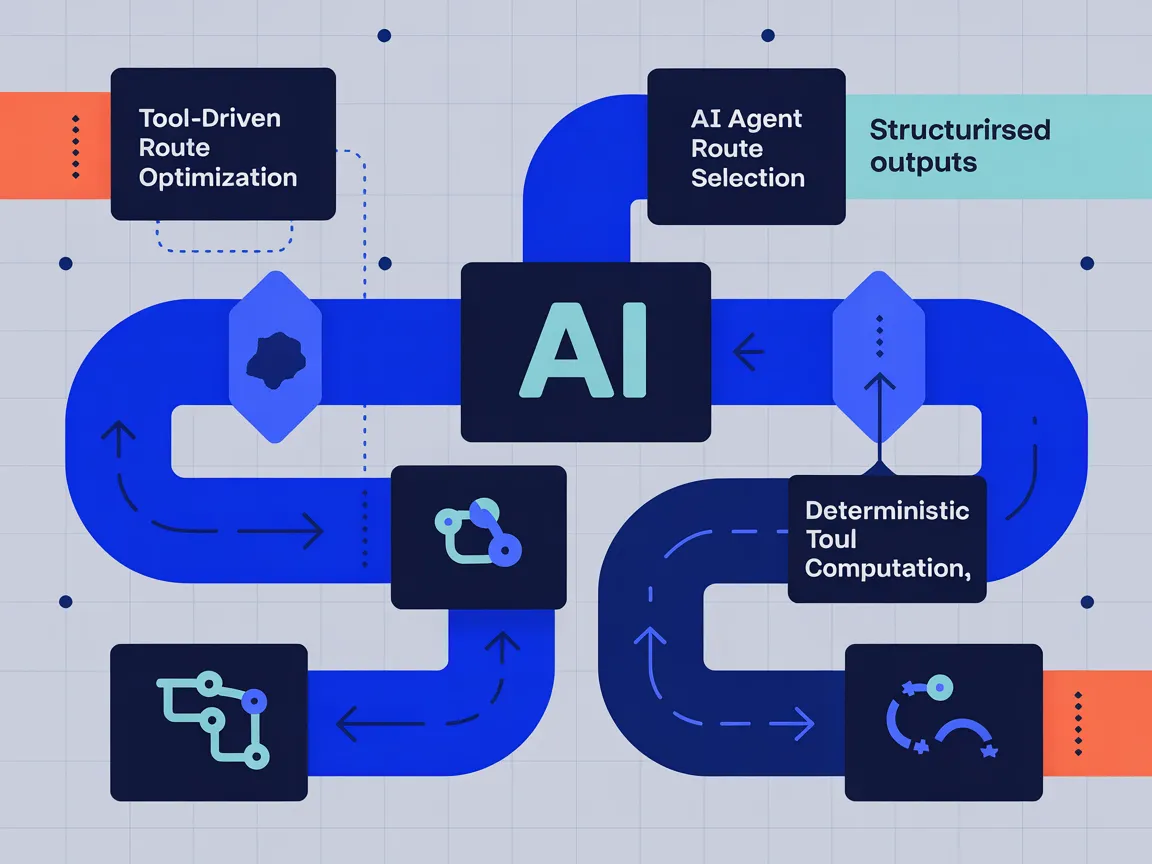
The tutorial outlines a tool-driven workflow, a paradigm where the AI agent's primary role is to intelligently select and sequence specialized external functions. Instead of a large language model (LLM) attempting to calculate a route from its training data, the agent is designed to call dedicated tools for geocoding addresses, computing distances via mapping APIs, and running optimization algorithms. This separation of reasoning from computation is fundamental. The LLM handles the high-level task understanding and planning—interpreting a dispatch request, breaking it down into steps—while offloading all precise mathematical and algorithmic work to the tools. This design guarantees that the distance between two points is always calculated the same way, according to a defined API, eliminating the variability and potential for 'hallucination' inherent in pure LLM responses.
Enforcing structured outputs is another critical pillar of the production-style system. In a logistics context, the result of a route optimization isn't a paragraph of text; it's a structured data object containing fields for driver ID, ordered waypoints, segment distances, cumulative ETAs, and total fuel estimate. The tutorial details how to use LangChain's capabilities to define Pydantic models or JSON schemas that the agent must adhere to, ensuring its final output is a clean, machine-readable data structure. This allows the agent's output to be seamlessly integrated into downstream systems for driver assignment, billing, and tracking without requiring error-prone parsing of natural language.
The workflow's architecture likely involves multiple agentic steps chained together. A primary orchestrator agent might first validate and clarify the input request, such as a list of delivery addresses and vehicle constraints. It would then invoke a geocoding tool to convert addresses to coordinates, followed by a distance matrix tool to compute travel times between all points. With this data prepared, the agent could call a dedicated route optimization tool—which might implement algorithms like the Traveling Salesperson Problem (TSP) or Vehicle Routing Problem (VRP) solvers—to determine the optimal sequence. Finally, a formatting step would ensure the final route plan conforms to the required structured output schema. Throughout this process, error handling and validation are built in, with the agent capable of detecting missing data or API failures and either retrying or escalating the issue.
This tutorial exemplifies the shift from using LLMs as chatbots to using them as the reasoning engine within robust, tool-augmented systems. For industries like logistics, transportation, and field service management, where decisions are based on dynamic, real-world data, an agentic workflow provides a path to automation that is both intelligent and reliable. It combines the flexible problem-solving and natural language interface of modern AI with the precision and determinism of traditional software, creating a hybrid system suited for high-stakes operational environments. The principles demonstrated—tool-driven design, deterministic computation, and structured outputs—are broadly applicable beyond logistics, serving as a blueprint for building trustworthy AI agents in finance, healthcare, and any domain where accuracy and integration are paramount.
Key Points
- 1The tutorial builds a Route Optimizer Agent for logistics using LangChain's agent APIs.
- 2It emphasizes a tool-driven workflow where the agent calls external functions for deterministic computations like distance and ETA.
- 3A core goal is to enforce structured, machine-readable outputs instead of unstructured text.
It provides a practical blueprint for moving AI agents from conversational demos to reliable, production-grade systems in operation-critical industries like logistics.